The Line of Dance
The Line of Dance is an imaginary line which represents the counterclockwise
flow of traffic around the dance floor. During traveling dances such as Waltz
and Tango, all dancers will move in the same general counterclockwise direction,
in order to minimize collisions.
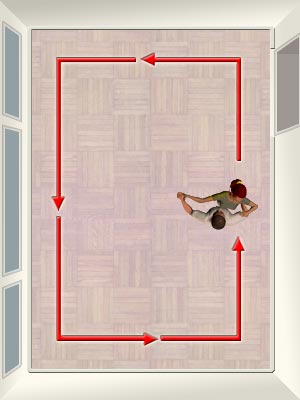
Fig.1 The Line of Dance
Spot vs. Progressive Dances
Every dance from Tango to Cha Cha can be categorized as either a
Spot Dance or a Progressive Dance.
Spot dances are characterized by movements which cause the dancers to remain
in one general area of the floor throughout the dance, whereas Progressive dances
contain movements that cause dancers to travel continuously. The Line of Dance
only applies to the latter category.
|
Spot Dances
(no line of dance)
- Cha Cha
- Rumba
- Bolero
- Swing/Jive
- Mambo/Salsa
- Merengue
|
|
Progressive Dances
(traveling around line of dance)
- Waltz
- Tango
- Viennese Waltz
- Foxtrot
- Quickstep
- Samba*
- Paso Doble*
|
* Note that all ballroom dances are classified as progressive dances,
while most Latin dances are classified as spot dances. The two exceptions to
this are Samba and Paso Doble, which have the distinction of being the only
Latin dances that travel around the line of dance.
Movement Around L.O.D.
As you can see in the illustration, the line of dance is more of a rectangle
than a circle (This is no accident, as most rooms are rectangular).
This divides the line of dance into two distinct areas: (1) Sides, and (2)
Corners. When dancing at the side of the room, you will travel along the
line of dance toward the corner. When the corner is reached, you turn the corner
and begin moving down the "new" line of dance.
Even during the progressive dances, not all movements will travel exactly
along the Line of Dance. Some movements can travel across it, weave in
and out, or even move against it for a short period of time. But the overall
movement should continue to progress in the direction of the Line of Dance.
The amount of wiggle room afforded to each dancer is dependent upon
many factors, including the floor size, number of dancers on the floor, the
dance, and the environment (e.g. social dancing, competition, showcase, etc).
As a general rule, it is best to use the sides of the room to travel.
The corners give you move flexibility to turn and change direction, since
everybody does the same here. Stationary figures, lines, and poses should be
reserved for the center of the room, where the flow of traffic is less
pronounced.